

In their daily work, agent teams rarely lose time on a single major task. The effort arises from many small handovers: notes from property appointments need to be transferred into structured fields, images require clean titles, documents must be retrievable, media needs to be ready for exposés and portals, and social media formats are often only created when marketing pressure is already high.
That’s precisely why AI in real estate CRM is no longer a future topic, but an operational question: Which tasks can be supported in such a way that property intake, documentation, and marketing become faster, without losing control and quality?
The timing is relevant. According to Destatis, by 2025, 26 percent of companies in Germany with at least ten employees were already using AI technologies; for companies with 250 or more employees, it was 57 percent. At the same time, the digitalization study by ZIA and EY shows that data management in the real estate industry is becoming the basis for efficiency, transparency, and AI applications. For agents, this means that AI unfolds its benefits not in isolated experiments, but where data, documents, and media converge anyway.
Why AI is now becoming a process question for agents
When it comes to AI, spectacular individual results are often discussed: a better image, a faster text, an automatically generated video. In the daily work of agents, however, it’s not the individual AI effect that matters, but its compatibility with the process. A good AI image is of little use if it then has to be exported, re-uploaded, manually approved, and given a suitable title.
For real estate agents, this leads to a concrete question of action: Which tasks regularly consume time in the property process but are easily verifiable by experts? This is precisely where AI has the greatest practical leverage. This includes on-site property intake, transferring existing data, media management, creating additional marketing formats, and structuring documents in the property file.
Governance is also becoming more important. The EU Commission points out that initial obligations from the AI Act have been in effect since February 2, 2025, including requirements for AI literacy and prohibited practices. For agent teams, this doesn’t mean making every AI use complicated. But it does mean using AI consciously: with clear responsibilities, human review, and traceable processes.
What problems AI in real estate CRM should really solve
A CRM for agents doesn’t become more modern just because an AI function appears somewhere. What’s crucial is whether the AI helps where friction occurs in daily business.
Typical agent problems include loose notes after property appointments, duplicate data entry for new properties, technical filenames in image galleries, too little format variety from existing image material, and unstructured property documents. Meaningful AI support addresses precisely these issues: it converts speech into structured property data, facilitates property creation, optimizes images, generates understandable image titles, creates video reels, and assists with document tagging.
The benefit in the CRM process arises from less work being lost between individual systems and roles. Notes become verifiable data, raw images quickly become marketable media, and uploaded documents become a more usable property file.
Checklist: How agent teams recognize good AI in CRM
- Does the AI directly assist with an existing property, image, document, or process?
- Do review, approval, and editorial responsibility remain with the agent team?
- Does the function reduce actual rework or does it create new export and upload steps?
- Are results in the CRM traceable, retrievable, and reusable?
- Does the AI support multiple process steps instead of just an isolated effect?
- Are there clear team rules for AI images, property details, document tags, and publications?
- Can the benefit be tested with real property data before the process is rolled out broadly?
This checklist does not replace a technical, legal, or data protection review. However, it helps agent teams evaluate AI not as an experiment, but as a process component in real estate CRM.
Practical Example: From Property Appointment to Marketable Property
An agent team takes on a new property. In the past, the second shift often began after the appointment: transferring notes, sorting images, naming documents, preparing exposés, and fielding team queries. With PropstackAI, this process can be more streamlined.
During the appointment, the agent speaks the most important key data into the app. The information is transcribed, transferred to structured fields, and documented as a note. Back in the office, the agent can supplement the property via quick setup and selectively transfer existing information. In parallel, energy certificates, floor plans, and other documents are uploaded and made more discoverable through automatic tagging.
Efficiently prepare media and documents for marketing
In the media section, property images are optimized. An empty room receives a more homely presentation via home staging, technical filenames are replaced by understandable image titles, and a reel for digital channels is created from selected images. The AI-generated images can be used more quickly by the agent for exposés and portals because approvals are set or adopted from the original image.
The result is not a fully automated agent process. What’s crucial is something more practical: loose information becomes verifiable CRM data, raw images quickly become marketable media, and uploaded documents become a more usable property file. This is precisely where the productive value of PropstackAI lies.
Best Practice: Don’t organize AI separately from CRM
Many AI tools solve individual tasks well. For agent teams, however, the additional effort often arises after the result: files have to be exported, checked, renamed, re-uploaded, and approved in the right place. This shifts work rather than reliably reducing it.
Therefore, the best practice is integrated use. AI should start where property information, images, documents, and marketing approvals already reside. This turns an AI action into a traceable workflow step within the CRM. The team remains responsible but gains speed and structure.
PropstackAI follows precisely this logic. The functions are not intended as a separate creative tool, but are integrated into the property and media process: at the property, in the app, in the media section, in the property file, and in marketing. This makes AI part of the workflow that agents already use.
How PropstackAI supports the journey from property appointment to marketing
PropstackAI is an add-on product in the Propstack real estate CRM and bundles several AI functions that support different phases of the agent process. Its strength lies in its breadth: voice input, quick setup, image editing, video reels, automatic image titles, automatic approvals, and document tagging all contribute to the same process.
1. Property Intake: Speak instead of transferring later
During on-site appointments, a lot of information is generated in a short time: address, features, condition, special characteristics, living space, price range, or open points. With AI voice input or voice-to-property, agents can speak property details into the Propstack app. The information is transcribed, analyzed, and assigned to appropriate property fields; the transcription is also retained as a note.
The benefit lies in the handover from the appointment to the CRM. Spontaneous observations become structured data that the team can then review and supplement. Especially for teams with external appointments, back office, and marketing, this reduces workflow discontinuities.
2. Property Creation: Fewer mandatory fields, ready faster
The quick setup helps teams create new properties in the system earlier. Instead of filling out many detailed fields directly, initially, only the category and address are needed. If data for this address already exists, users can selectively choose which values to adopt.
This is relevant for agents because property creation is often the starting point for subsequent processes: tasks, exposé, portal transfer, internal coordination, and owner communication. The faster a property is cleanly set up, the sooner it becomes operationally usable.
3. Media: Make images marketable faster
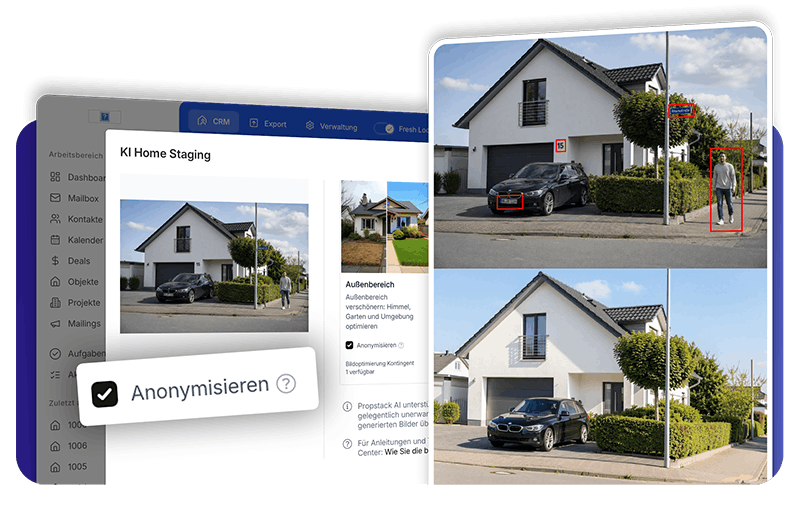
This brings image work closer to the marketing process. An empty room can appear more homely, an outdoor area can be better prepared, and simple optimizations don’t necessarily have to go through external intermediate steps. Expert review remains important, but the creation of initial variants becomes significantly faster.
Especially with outdoor shots, data protection also plays an important role. Therefore, PropstackAI offers an option for anonymizing sensitive image content for edits in outdoor areas. The function is activated by default and helps to protect, for example, personal or other sensitive information in outdoor shots for marketing purposes. This way, agents retain control over their image content and can use real estate photos more data-sensitively in exposés and real estate portals.
4. Approvals and Image Titles: Less rework in the media section
AI-generated images are only helpful if they can then be used correctly in the exposé or for portal transfer. PropstackAI-generated images are activated by default for portals and exposés or adopt the approval settings of the original image. Individual images can still be manually deactivated.
Additionally, PropstackAI can recognize technical filenames and automatically generate descriptive image titles if no meaningful title is present. A filename like DSC_0042.png thus becomes a more understandable designation for the gallery, exposé, and internal media overview.
5. Reels and Documents: More reach, better property file
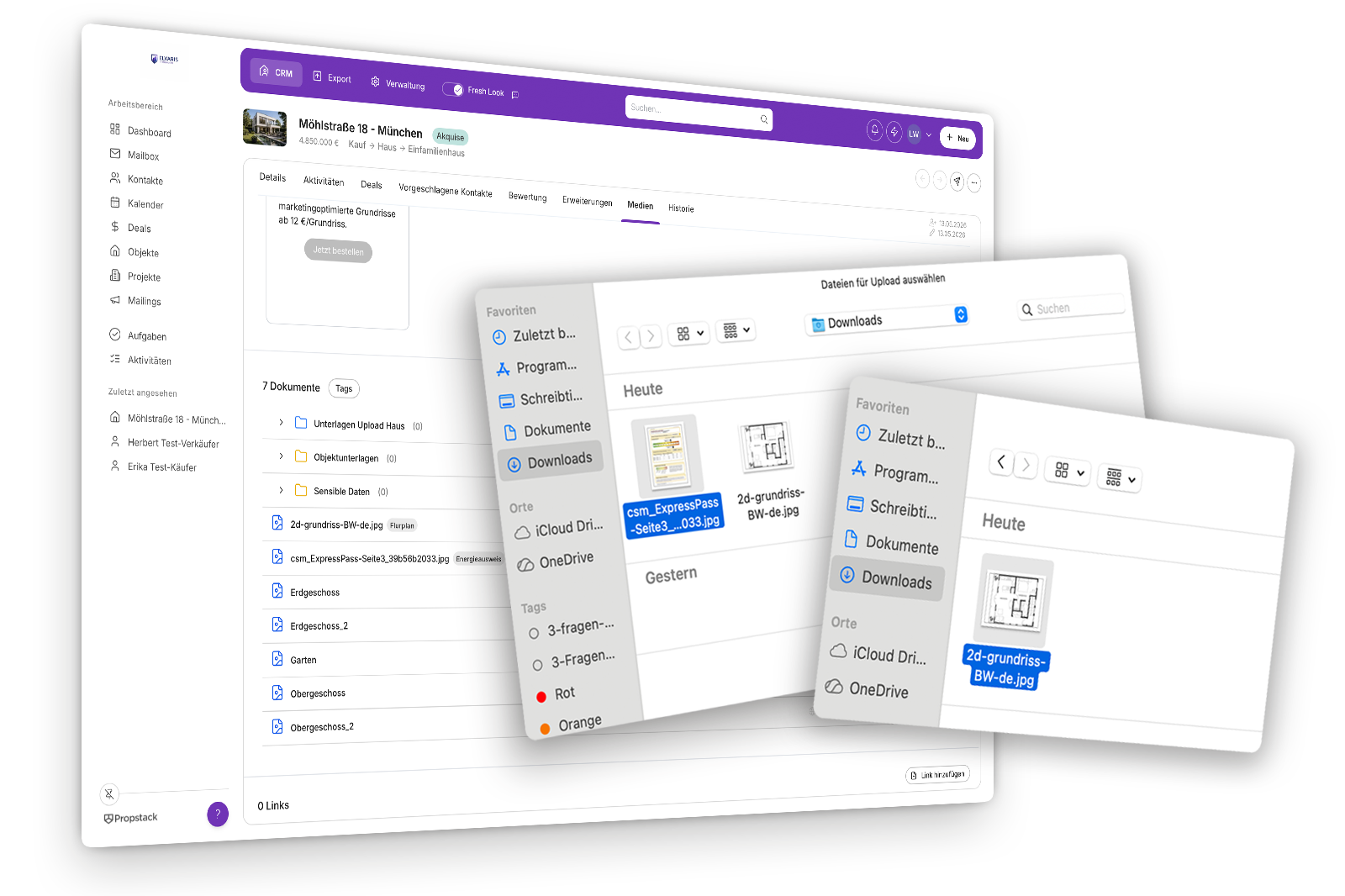
In the property file, automatic document tagging helps. Newly uploaded property documents are analyzed, suitable tags from the configured tag list are suggested, and directly applied with high recognition confidence. Documents such as energy certificates, floor plans, or land register excerpts thus become more discoverable.
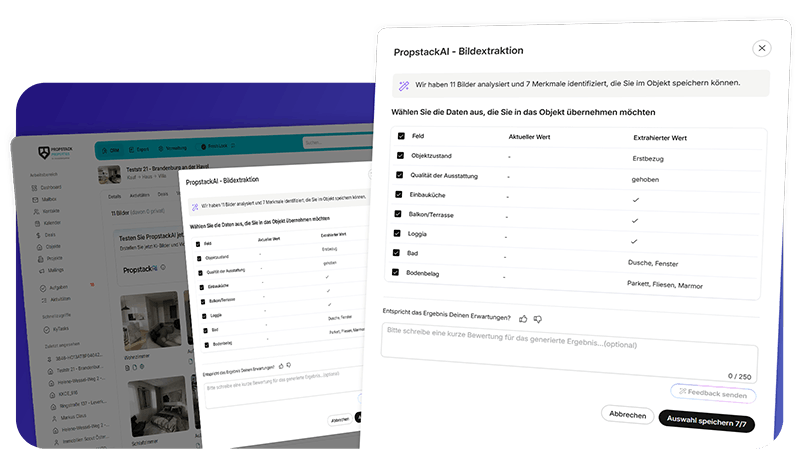
In the future, PropstackAI will expand this approach with AI image recognition. Relevant property features are to be recognized directly from real estate images, and suitable values for property fields will be suggested – for example, for furnishings, balcony or terrace, bathroom features, or floor coverings. The goal is to further reduce manual data entry and provide even stronger support for property management.
AI supports the entire daily work of agents
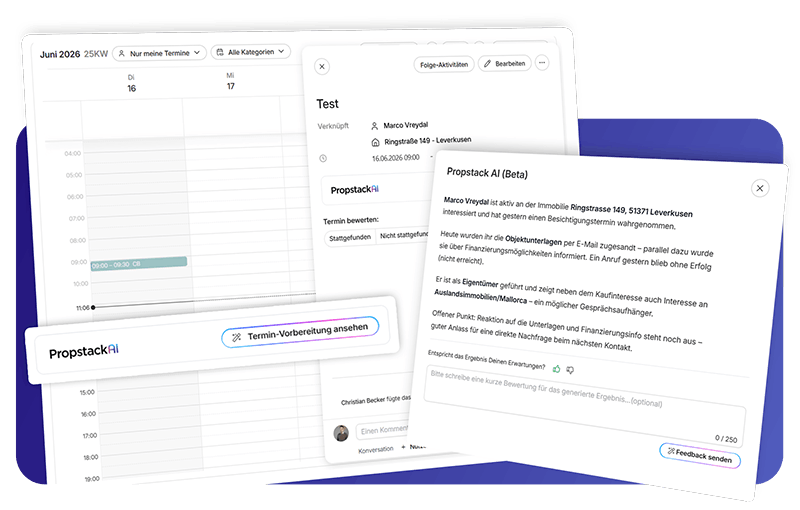
PropstackAI is continuously being expanded. One example is AI appointment preparation. This automatically consolidates relevant information from emails, deals, properties, and notes in the context of an upcoming appointment. Agents thus get a quick overview of important discussion points, open tasks, and previous contacts – without having to gather information from various areas.
Together with functions such as voice input, document tagging, and the planned AI image recognition, PropstackAI is gradually developing into integrated support along the entire agent process. The goal is not to automate decisions, but to simplify recurring work steps and give teams more time for consulting, marketing, and customer contact.
How an agent team can effectively implement PropstackAI
- Identify recurring time-wasters: Consider property intake, media management, document search, exposé preparation, and social content separately.
- Choose a real property process as a test case: ideally a property with data, images, and documents, not just an isolated example image.
- Test AI functions in the workflow: voice input during intake, quick setup at property start, image functions in the media section, and tagging in the property file.
- Professionally review results: Check property data, image impact, approvals, titles, and tags before publishing or sharing.
- Define team rules: Who can approve AI images, who reviews property details, which document tags are binding, and when is a result manually adjusted?
- Evaluate benefits: Key factors are less rework, faster market readiness, better discoverability, and clearer team handovers.
Why PropstackAI is strategically more than an image tool
Image optimization and home staging are visible AI applications. For an agent team, however, the connection to further process steps is at least as important. PropstackAI supports not only visual presentation but also property intake, data transfer, media approvals, image titles, reels, and document structure.
This makes Propstack relevant as a process platform: data, media, and documents are not left in separate tools, but are processed within the context of the property process. For teams with multiple properties, roles, and responsibilities, this structure is often more important than a single perfect AI result.
Therefore, when evaluating PropstackAI, one should not only ask whether an image looks better. The better question is: How much rework disappears between property appointment, property creation, media management, documentation, and marketing launch?
Test PropstackAI with real property processes
AI voice input, automatically generated exposés and 3D models, and virtual interior design – PropstackAI takes the daily work of agents to the next level. Digital. Traceable. Efficient.
Test PropstackAI now!
Experience how modern AI functions can support real estate marketing, property preparation, and marketing readiness.
Conclusion
AI in real estate CRM is not an end in itself. For agents, what matters is whether a system genuinely simplifies work: capturing property data faster, preparing images more professionally, structuring documents better, creating reels more easily, and bringing media to market faster.
PropstackAI shows how this benefit can arise in the CRM process. The functions intervene at multiple points in the property workflow, making AI more practical than an isolated add-on tool. This is strategically relevant for agent teams because property intake, media production, and documentation do not have to be optimized separately.
The most important benchmark remains one’s own daily routine: Which property processes take too long? Where does duplicate entry occur? Which media work is neglected? Where are documents being searched for? If these questions are answered with real property data, it becomes clear where PropstackAI has the greatest leverage in the daily work of agents.
Sources and Notes
- Federal Statistical Office (Destatis), Companies using artificial intelligence technologies by employee size classes, as of November 24, 2025.
- Bitkom, Artificial Intelligence in Germany, Study Report 2026 based on representative surveys 2025.
- ZIA/EY, Digitalization Study 2025 of the Real Estate Industry, Data Lifecycle Management in Real Estate.
- European Commission, AI Act – Regulatory framework on artificial intelligence, Application timeline.
FAQ
AI in real estate CRM means that recurring tasks related to property data, images, documents, and marketing are directly supported within the CRM. For agents, this is particularly valuable when AI doesn't run alongside the work process, but rather captures data more structured, prepares media faster, and makes property files more usable. The benefit thus arises not from automation at any cost, but from less manual rework while maintaining expert control.
PropstackAI supports property intake, among other things, with AI voice input or voice-to-property. Agents can speak property details into the app; the information is transcribed, analyzed, and assigned to appropriate property fields. This is particularly helpful for on-site appointments, as information is transferred more quickly from conversation or tour into structured CRM data. The results should then be professionally reviewed and supplemented.
For real estate marketing, AI functions that accelerate image and media work are particularly relevant. PropstackAI supports image optimization, home staging, additional image variants, automatic image titles, and video reels from existing image material. This allows agent teams to move from raw material to marketable media more quickly. It remains important to check every result for factual correctness, visual impact, and approval before publication.
A separate AI tool can deliver individual results, but often creates new intermediate steps: export file, save result, re-upload, adjust title, and set approvals. AI directly in CRM reduces this friction because the property, media, and documents are already in the work context. PropstackAI is therefore particularly strong where AI results can be immediately reused in the property process. This saves time and makes team handovers more traceable.
Yes. PropstackAI can analyze newly uploaded property documents and suggest suitable tags from the configured tag list or apply them directly with high recognition confidence. This helps agent teams find documents such as energy certificates, floor plans, or land register excerpts more quickly. The benefit lies in a better-structured property file, less manual tagging, and faster access for consulting, owner communication, or marketing.
No. AI in agent CRM should support work processes, but not replace professional and editorial responsibility. Property details, images, titles, document tags, and publication approvals must still be reviewed by the team. Precisely because real estate marketing requires trust, diligence, and legal sensitivity, human control is a central component of the process. PropstackAI is therefore to be understood as support for verifiable work steps.
The AI Act makes it clear that AI use in Europe is being more strongly regulated and consciously organized. For agent teams, the main focus is a pragmatic question: Who uses AI, for what, with what review, and with what team rules? The article does not replace legal advice, but it shows the operational point: AI should be used traceably, controlled, and with sufficient understanding. This is precisely why clear processes in CRM are important.